Parts of the BMS
Freedom to design each HV battery pack for its application.
Each kind of edge device comes in variants, to match the cell count, sensors, current range and high-voltage functions of each design, for cells of any chemistry. Each is designed to arrive pre-certified, to the ASIL it needs, up to ASIL D.

Battery module monitors
A variant for every module design
One on each module, chained to the next, so a larger HV battery pack takes more of them.
Variants for
- Cell count
- Temperature sensors
- Other sensors
A conventional BMSOne BMS board for a set number of cells, redesigned when the module changes.
High-voltage monitoring and control
Channels and ranges to match each design
Edge devices measure high voltage, current and isolation and drive the contactors.
Variants for
- HV channels
- Current range
- Contactors
A conventional BMSA junction box and a separate BMS controller, each with its own firmware.
Thermal management
Coolant temperatures and pumps
Edge devices measure the coolant temperatures and control the pumps, configured with the rest of the BMS.
A conventional BMSA separate thermal controller, with its own MCU and firmware.
Thermal event monitoring
Added when a customer asks
Thermal event detection plugs in as one more edge device and is configured with the rest. Nothing else in the BMS changes.
A conventional BMSA separate sensor box with its own MCU and firmware, integrated on the bus.
Custom edge devices
Any other sensor or actuator
For a sensor or actuator outside the catalogue, an edge device can be shaped to the customer’s needs, configured like the rest.
A conventional BMSA new BMS variant, or another box beside it.
Line to the controller
No BMS software to maintain
One Ethernet line runs to the customer’s zonal or central controller, where the battery software runs. The device drivers come with the edge devices.
A conventional BMSA BMS controller in the HV battery pack, its software released and maintained by its supplier.
Prototyping and validation
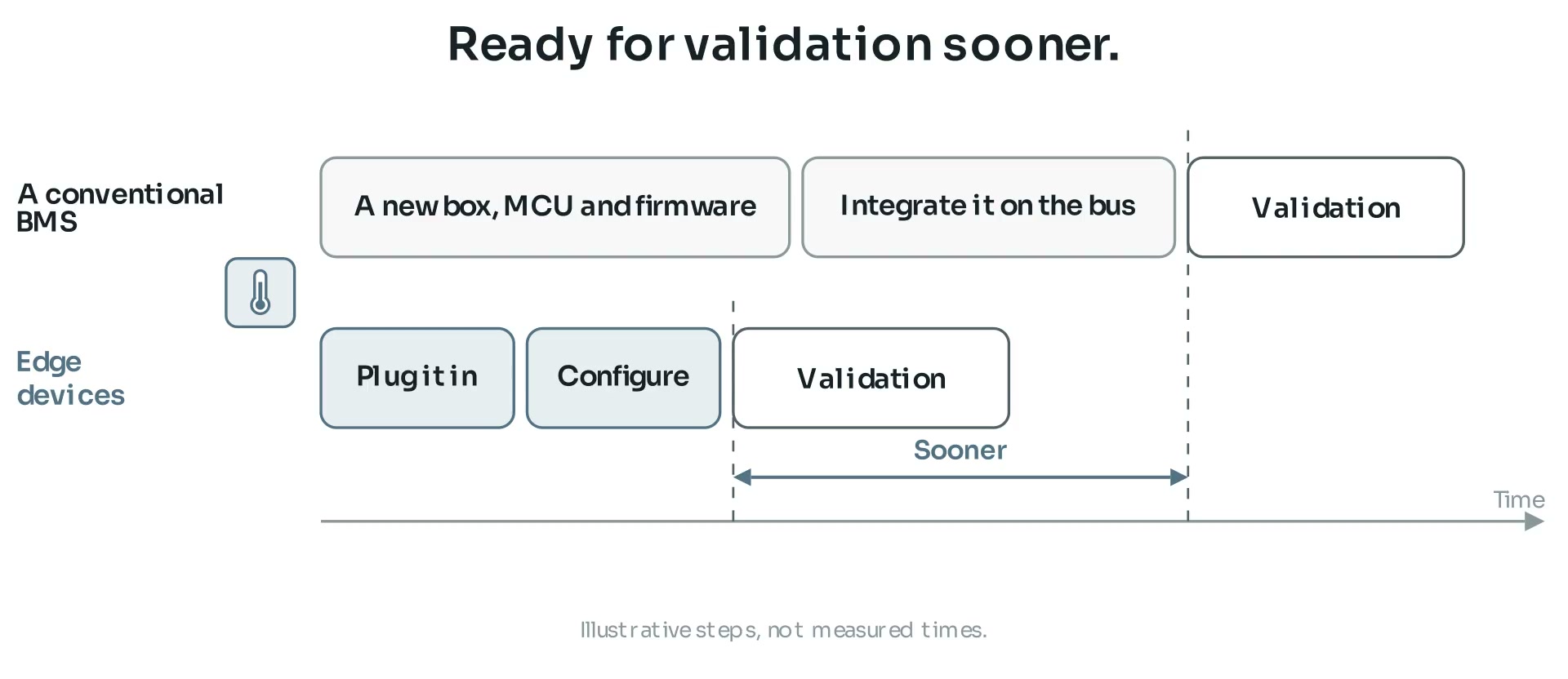
Concept to validation at the pace of choosing edge devices.
Between a change and an HV battery pack ready to validate, there is only an edge device to plug in and a configuration.
Questions HV battery pack suppliers ask
Can an existing HV battery pack design move to edge devices?
Yes. The edge devices are picked in the variants that match its modules, its high-voltage side and the functions it adds.
Which cells and voltage classes do the edge devices suit?
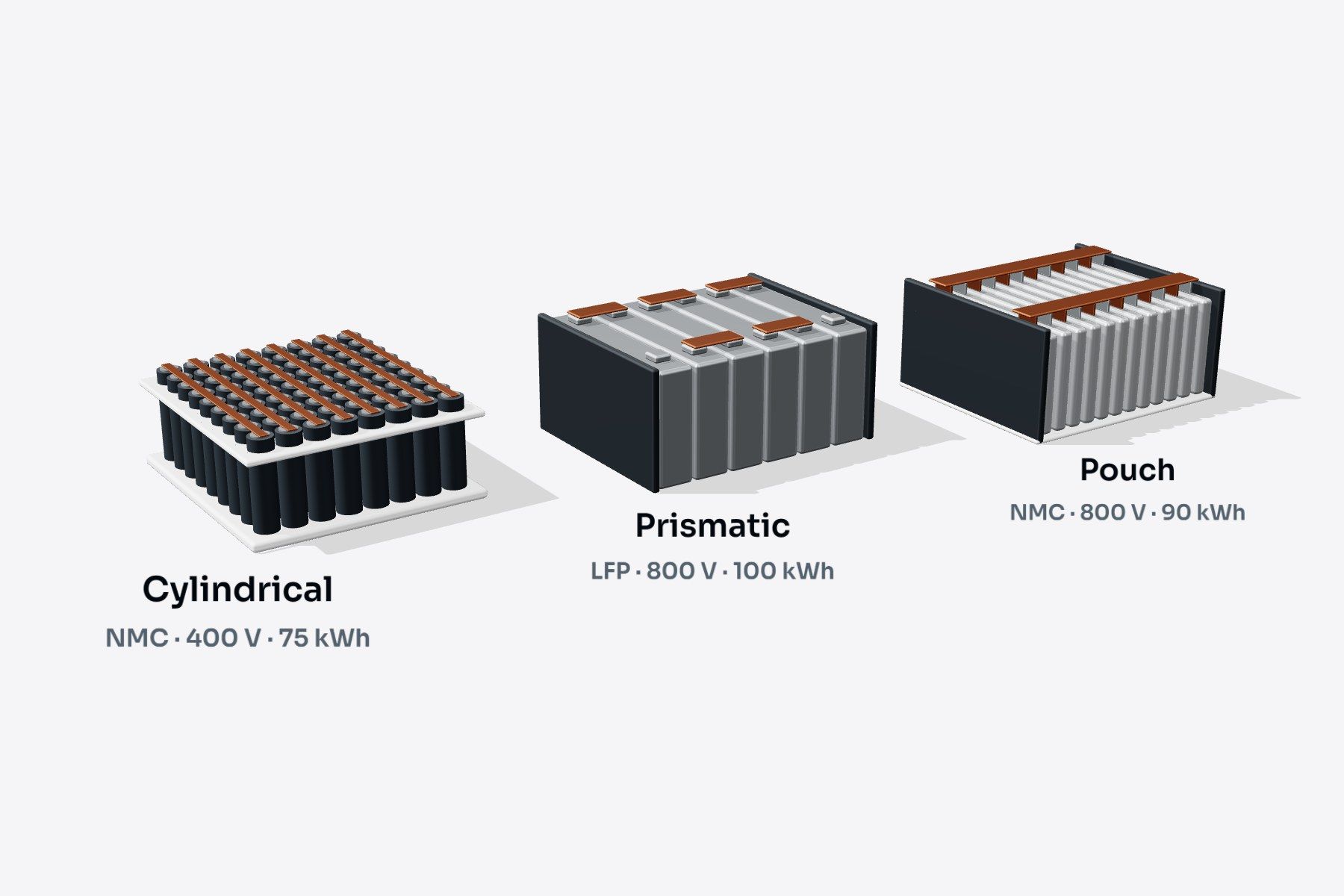
Prismatic, pouch and cylindrical cells of any chemistry, in HV battery packs up to 1500 V.
How is an HV battery pack validated before delivery?
With its edge devices fitted. A desktop application configures them and monitors every reading during the tests.
Who writes and maintains the battery software?
The vehicle maker or the storage integrator, in its own zonal or central controller. The HV battery pack supplier has no BMS software to write or maintain.
Which safety and security standards apply?
The edge devices are designed to ISO 26262 for functional safety and ISO 21434 for cybersecurity. With no firmware of their own, their safety documents stay the same when the battery software changes.
Do the same edge devices serve vehicles and storage?
Yes. HV battery packs for vehicles and for storage are built from the same kinds of edge devices, in the variants each HV battery pack needs.